

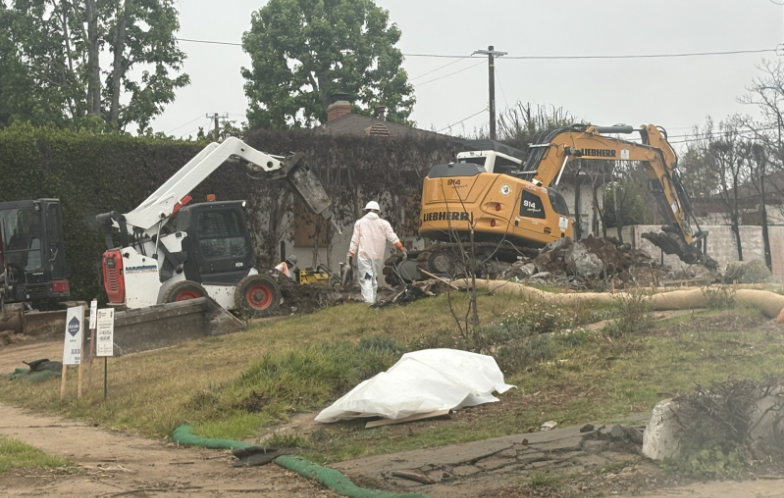
Worker engaged in post-fire clean-up activities in the Pacific Palisades.
August 26, 2026
In the aftermath of the devastating January 2025 Los Angeles County wildfires—which destroyed an estimated 16,000 structures across Altadena, Pacific Palisades, and other communities—a massive workforce was mobilized to begin the long and arduous work of cleanup and recovery. Among the many workers drawn into these efforts were day laborers and domestic workers, an informal and often economically precarious workforce of individuals hired by homeowners and contractors for a wide range of tasks in and around residential properties.
Researchers and journalists have noted the important disaster roles that day laborers and domestic workers have played following hurricanes and major storms in other parts of the country (Retka et al., 2023; Theodore, 2022; Delp et al., 2009). The Los Angeles fires afforded an opportunity to document the experiences of this workforce on the post-wildfire frontlines—and to do so in real time as the recovery efforts unfolded.
Beginning in spring 2025, LOSH partnered with the Instituto de Educación Popular del Sur de California (IDEPSCA) and the National Day Laborer Organizing Network (NDLON) to survey day laborers and domestic workers in Los Angeles County. Between May and August, we interviewed a total of 151 workers who had taken on cleanup and recovery jobs in the aftermath of the wildfires. Respondents were predominantly Latino men (82.4%) with an average age of 48.9 years. About half (42.4%) had secured recovery work through a local community organization in the immediate wake of the fires; others reported having been hired by contractors (21.2%), homeowners (17.7%) or other employers (18.8%).1
Many day laborers and domestic workers were assigned hazardous tasks at fire-impacted properties. The most common tasks included cleaning ash, soot and debris (81.2%), clearing burned plants (68.2%), demolition (27.1%), and landscaping (25.9%). In addition to encountering widespread ash and soot in their work, many respondents reported working around burnt and/or unstable structures (62.4%), broken glass and sharp objects (58.8%), and extreme heat (54.1%), among other hazards.
Workers’ access to protections was uneven and varied significantly by employer type. Workers hired by homeowners and contractors often worked without respirators or other personal protective equipment (PPE), let alone respirator training and fit testing.2 One in five (21.2%) workers reported at least one negative experience with their employer such as underpayment or no payment, insults or threats, or being forced to work more hours than agreed.
Workers’ self-reported health outcomes and injuries reflect the hazardous nature of their work and uneven access to PPE. Approximately 68% of workers reported health symptoms such as nose and throat irritation, eye irritation, and coughing. Over one-third (37.6%) of workers reported injuries such as bruises, cuts, lacerations, and punctures resulting from this work.
Many workers took on wildfire recovery jobs in a context of severe economic precarity. Over half (56.5%) of respondents were either at risk of losing housing or currently experiencing houselessness. Approximately 86% of workers reported losing out on their typical work because of the fires, not being able to access the sites where they typically seek work, and other negative financial impacts.
This research demonstrated the important role that day laborers and domestic workers have played in post-fire recovery efforts throughout Los Angeles County – a role that has gone largely unrecognized. Our findings underscore the greater precarity these workers face when hired through more informal employment arrangements to perform tasks in disaster zones for which they have not been adequately trained.
As communities across Los Angeles County continue along the road to recovery, continued education for employers and stronger regulatory interventions at the local and state levels are necessary to ensure protections for this vital disaster workforce.
This research was supported by funds from the California Climate Action Seed Grants of the University of California, Grant Number RO2CP7263.
Notes
- Other employers include business owners, real estate agents, and friends.
- Workers hired by a trusted local community organization for fire-recovery work were more likely than those hired by homeowners or contractors to receive respiratory protection, fit testing, and training, as well as other forms of PPE.
Bibliography
Retka, J., McCabe, S., Huang, J., & Zamudio, M.A. (2023, September 28). Toxic Labor. The Center for Public Integrity. https://publicintegrity.org/environment/toxic-labor/toxic-labor-disaster-workers/
Theodore, N. (2022). Recovering from climate disasters: immigrant day laborers as “second responders.” University of Illinois Chicago Center for Urban Economic Development. https://ndlon.org/wp-content/uploads/2022/04/Recovering-from-Climate-Disasters-Report-2.26.22.pdf
Delp, L., Podolsky, L., & Aguilar, T. (2009). Risk amid recovery: occupational health and safety of Latino day laborers in the aftermath of the gulf coast hurricanes. Organization & environment, 22(4), 479–490. https://doi.org/10.1177/1086026609347193
